
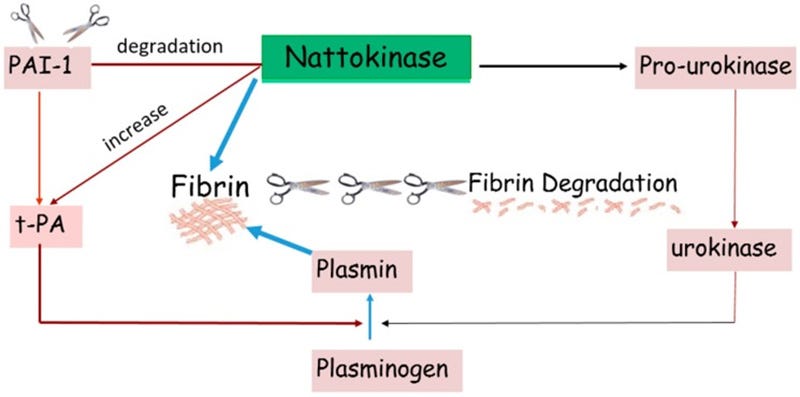
Nattokinase has been widely touted for its proposed ability to remove Spike from our bodies. I would like to propose that it actually does something that may be of equal, or perhaps greater benefit. Nattokinase may help put a full stop to the thromboinflammation and neuropathology in COVID-19. This is why a natural fibrinolytic enzyme such as nattokinase deserves a closer look.
We have known essentially from the beginning that severe COVID-19 (and Long COVID) is associated with coagulation abnormalities, endothelial injury and extensive fibrin deposition. Today I would like to discuss a remarkable 2024 study published in Nature which suggests that fibrin may be much more than a bystander.
The researchers found that SARS-CoV-2 Spike protein binds directly to fibrin and fibrinogen.
Here we show that fibrin binds to the SARS-CoV-2 spike protein, forming proinflammatory blood clots that drive systemic thromboinflammation and neuropathology in COVID-19. Fibrin, acting through its inflammatory domain, is required for oxidative stress and macrophage activation in the lungs, whereas it suppresses natural killer cells, after SARS-CoV-2 infection. Fibrin promotes neuroinflammation and neuronal loss after infection, as well as innate immune activation in the brain and lungs independently of active infection.
Fibrin drives thromboinflammation and neuropathology in COVID-19
https://www.nature.com/articles/s41586-024-07873-4
And what happens next is particularly important.
The Spike–fibrin interaction produces pro-inflammatory blood clots that can drive thromboinflammation. Fibrin was shown to contribute to oxidative stress and macrophage activation in the lungs, suppress natural killer-cell responses, and promote neuroinflammation and neuronal injury.
In other words:
Spike + fibrin may create a pathological feedback loop.
This leads to a logical question: What if preserving fibrinolytic (breaking down fibrin) capacity before and during infection could help prevent this cycle from becoming established?
Enter nattokinase.
Nattokinase is a fibrinolytic enzyme produced during the fermentation of soybeans by Bacillus subtilis. Human studies have demonstrated that oral nattokinase can increase markers of fibrinolysis and influence several components of the coagulation system.
One controlled human study found that nattokinase increased D-dimer and fibrin/fibrinogen degradation products while reducing factor VIII activity—evidence that it can shift the hemostatic system toward fibrinolysis.
A double-blind, placebo-controlled cross-over NK intervention study was carried out in 12 healthy young males. Following the baseline blood draw, each subject was randomized to receive either a single-dose of 2,000 FU NK (NSK-SD, Japan Bio Science Laboratory Co., Ltd) or placebo with subsequent cross-over of the groups. Subjects donated blood samples at 2, 4, 6 and 8 hours following administration for analysis of coagulation/fibrinolysis parameters. As a result, D-dimer concentrations at 6, and 8 hours, and blood fibrin/fibrinogen degradation products at 4 hours after NK administration elevated significantly (p < 0.05, respectively). Factor VIII activity declined at 4 and 6 hours (p < 0.05, respectively), blood antithrombin concentration was higher at 2 and 4 hours (p < 0.05, respectively), and the activated partial thromboplastin time prolonged significantly at 2 and 4 hours following NK administration (p < 0.05 and p < 0.01, respectively). All the changes, however, were within the normal range. In conclusion, thus, a single-dose of NK administration appears enhancing fibrinolysis and anti-coagulation via several different pathways simultaneously.
A single-dose of oral nattokinase potentiates thrombolysis and anti-coagulation profiles
https://pmc.ncbi.nlm.nih.gov/articles/PMC4479826/
If excessive fibrin is not simply an unfortunate consequence of COVID—but is actually participating in thromboinflammation, macrophage activation, endothelial injury and neurological pathology—then maintaining the ability to efficiently clear fibrin could potentially be protective.
Let’s look at the sequence:
Spike → fibrin binding → inflammatory clot formation → macrophage activation → endothelial injury → microvascular dysfunction
Nattokinase potentially attacks the process from another direction:
Nattokinase → enhanced fibrinolysis → less fibrin substrate → potentially less inflammatory clot burden
Please bear in mind that this hypothesis is NOT proof that nattokinase prevents severe COVID. We need clinical trials specifically testing that question, and I hope that those with labs reading this will endeavor to answer that question. Always consult your primary care provider before using any medication or supplement.
Sometimes the most promising therapeutic target isn’t the pathogen itself—but the pathological process it triggers.
Thank you, as always, for keeping me going. I appreciate all of your support and am grateful to everyone in our community. Please have a blessed weekend.
One-Time Donation
https://buy.stripe.com/6oUbJ0auFaWkcLs2ZXeUU00
Wholeheartedly agree re the massive protective benefits & potential of nattokinase, both cardiovascularly in general and vis a vis SPED. Somehow I learned about it way early in the timeline we know as the Covid era, along with several other natural compounds and supplements (some of which I was already taking in, some not). Am looking at a bottle of Nattokinase sitting in front of me now, would not miss a day (need to take a sufficient amount for protective effects, e.g. 8K to 10K FU), at least that is my understanding) and I feel the results personally speak for themselves. Thank you Walter, more research would be of tremendous value imho.
Thank you for the update. I have been utilizing nattokinase & serrapeptase for years.
I look forward to more information.